A participatory design project that translated the needs of residents, council representatives and housing developers into a shared platform for local planning conversations.
City of Casey
2023
UX Researcher · Product Designer
UX Research · Product Design · Co-design

Overview
Talk to Casey explored how residents, council representatives and housing developers could communicate more effectively when planning urban green spaces.
Urban development decisions affect many groups, but these groups do not always have equal access to information or a shared way to discuss priorities. The project investigated how participatory activities and a digital platform could support more visible and inclusive communication.
I contributed to planning and facilitating two workshops with 14 participants representing the three stakeholder groups. The workshops explored the purpose of green spaces, preferred neighbourhood facilities, competing urban priorities and barriers to communication.
I then translated the findings into a mobile product concept that allows stakeholders to enter discussions through clearly identified roles, participate in topic-based channels and vote on community priorities.
Challenges
Urban planning requires residents, councils and developers to work within different realities.
Residents bring direct knowledge of daily life in their neighbourhoods, but may not understand planning regulations or know which council team to contact. Council representatives need to balance public expectations with policy, budgets and long-term responsibility. Developers must consider feasibility, approvals, resources and delivery constraints.
Traditional consultation can collect feedback without helping participants understand what happens next. Communication may be distributed across meetings, documents, forms and separate channels, making it difficult to follow an issue over time.
The challenge was to create a process in which each stakeholder group could contribute meaningfully, understand other perspectives and see how priorities were being discussed.
The project also needed to translate complex planning topics into activities that participants could engage with without specialist knowledge.
Design Approach
Fourteen participants took part in the research: seven residents, three council representatives and four housing developers. Participants completed activities from assigned stakeholder perspectives, encouraging them to consider needs beyond their own.
During the first workshop, participants ranked eight functions of green space. They then used a grid-based “Colour Your City” activity to distribute housing, nature, facilities and other urban elements across a hypothetical neighbourhood.
Participants also constructed ideal neighbourhoods using visual cards. This made abstract planning preferences tangible and revealed where priorities aligned or competed.
The second workshop focused on communication barriers. Participants considered the difficulties experienced by other stakeholder groups rather than speaking only from their usual position.
Additional activities helped prioritise facilities for green spaces. Bins, jogging tracks and public toilets received the strongest support, followed by shelters and benches. Participants also reviewed colour directions for the proposed digital platform.
The selected palette combined greens and yellow with dark blue, balancing references to nature with a sense of civic trust.
Goal
The goal was to investigate how co-design could support more transparent conversations about local green spaces and neighbourhood development.
The research aimed to:
Identify the functions people value in urban green spaces
Reveal shared and conflicting stakeholder priorities
Understand barriers within existing communication processes
Explore accessible ways of discussing planning decisions
Translate the findings into a digital participation concept
The final product was not intended to replace formal planning or council processes. It was designed as a shared communication layer through which stakeholders could raise issues, exchange perspectives and make participation more visible.
Solution
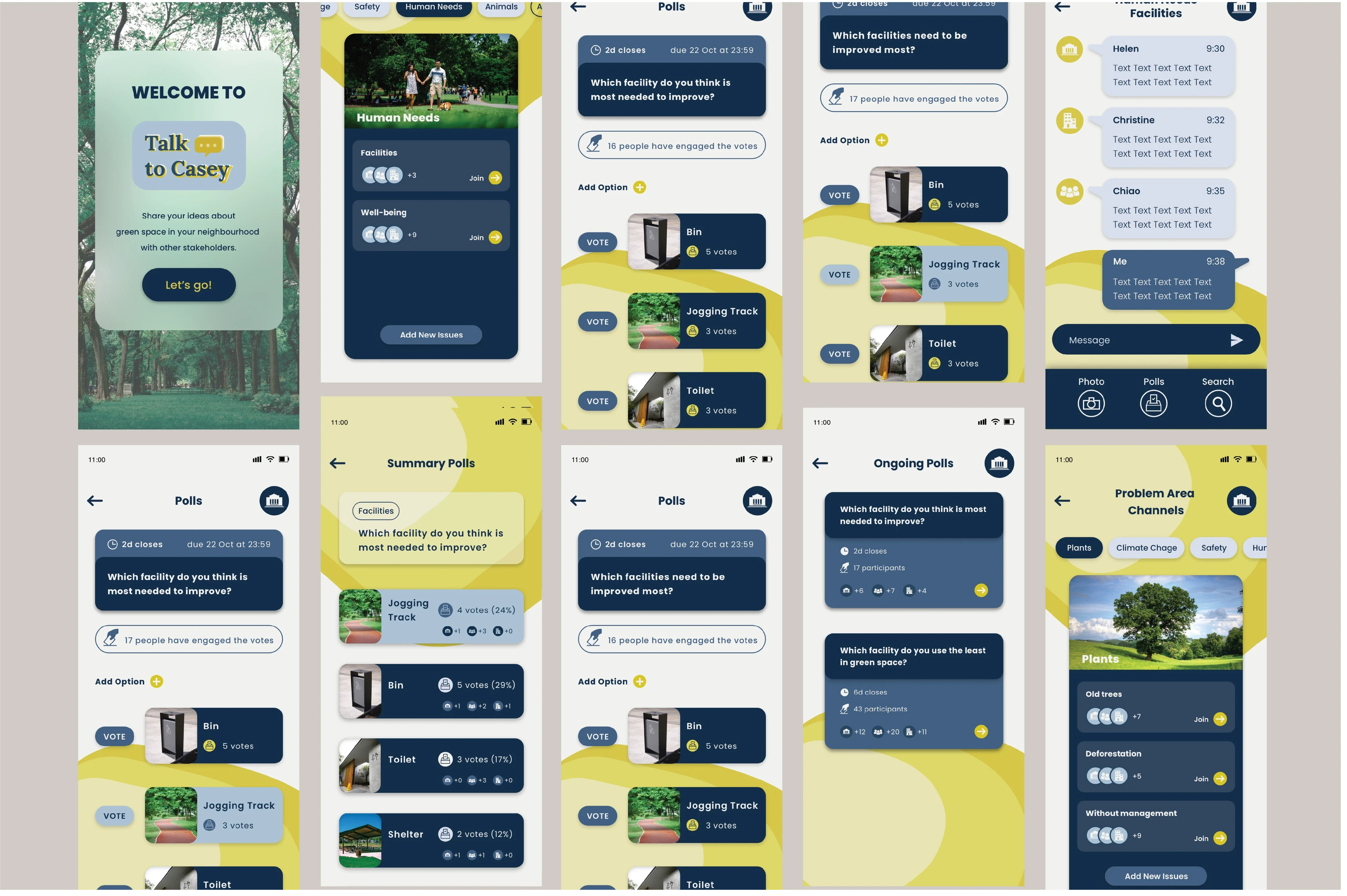
The research informed Talk to Casey, a mobile platform where residents, council representatives and developers can discuss neighbourhood issues and participate in shared decisions.
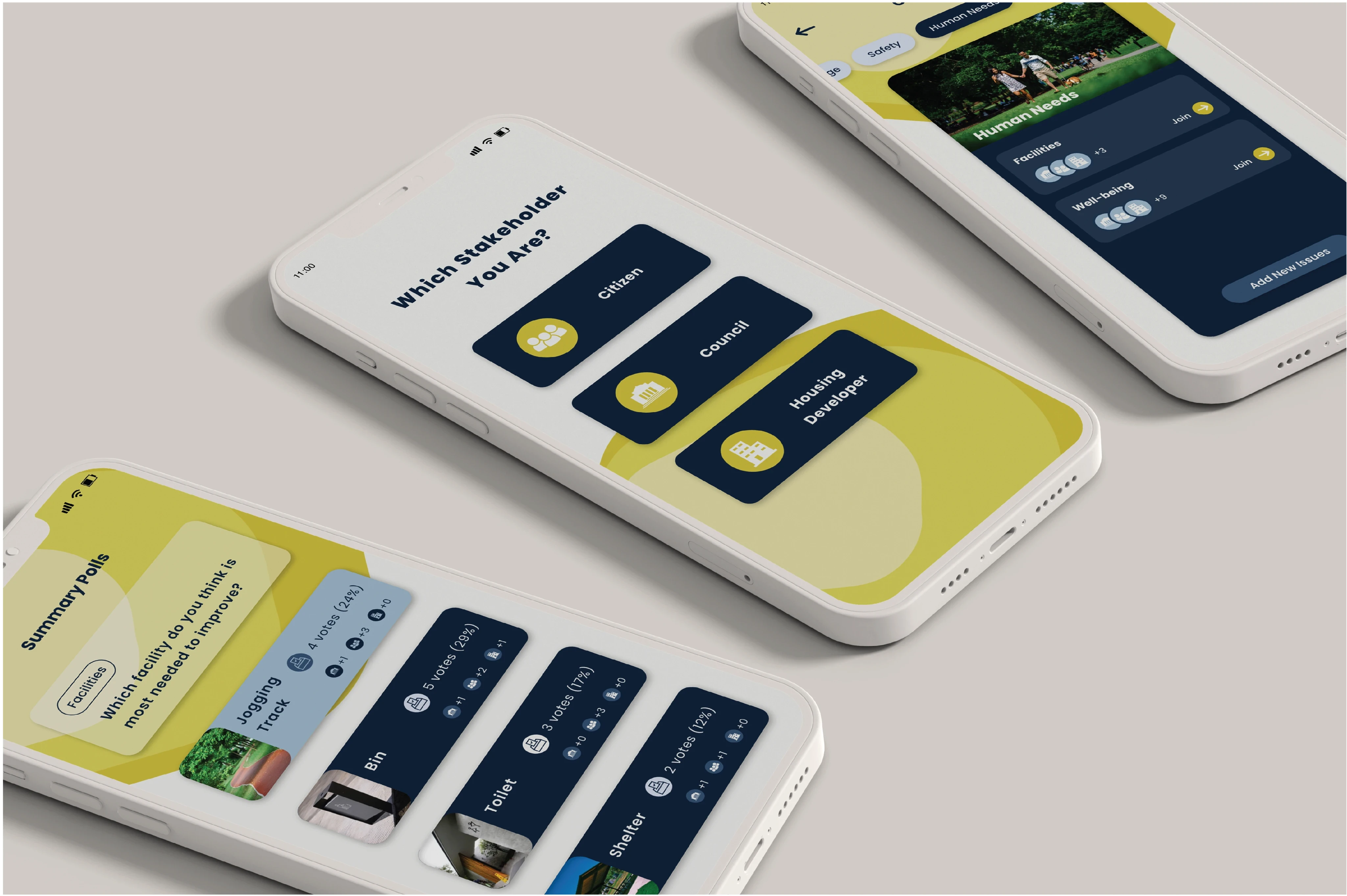
Users begin by identifying their stakeholder role. This makes participation more transparent and allows the platform to present relevant discussions and responsibilities without separating the groups completely.
Community channels organise discussions around themes such as facilities, wellbeing, plants, climate, safety and human needs. Users can raise issues, contribute perspectives and follow topics relevant to their neighbourhood.
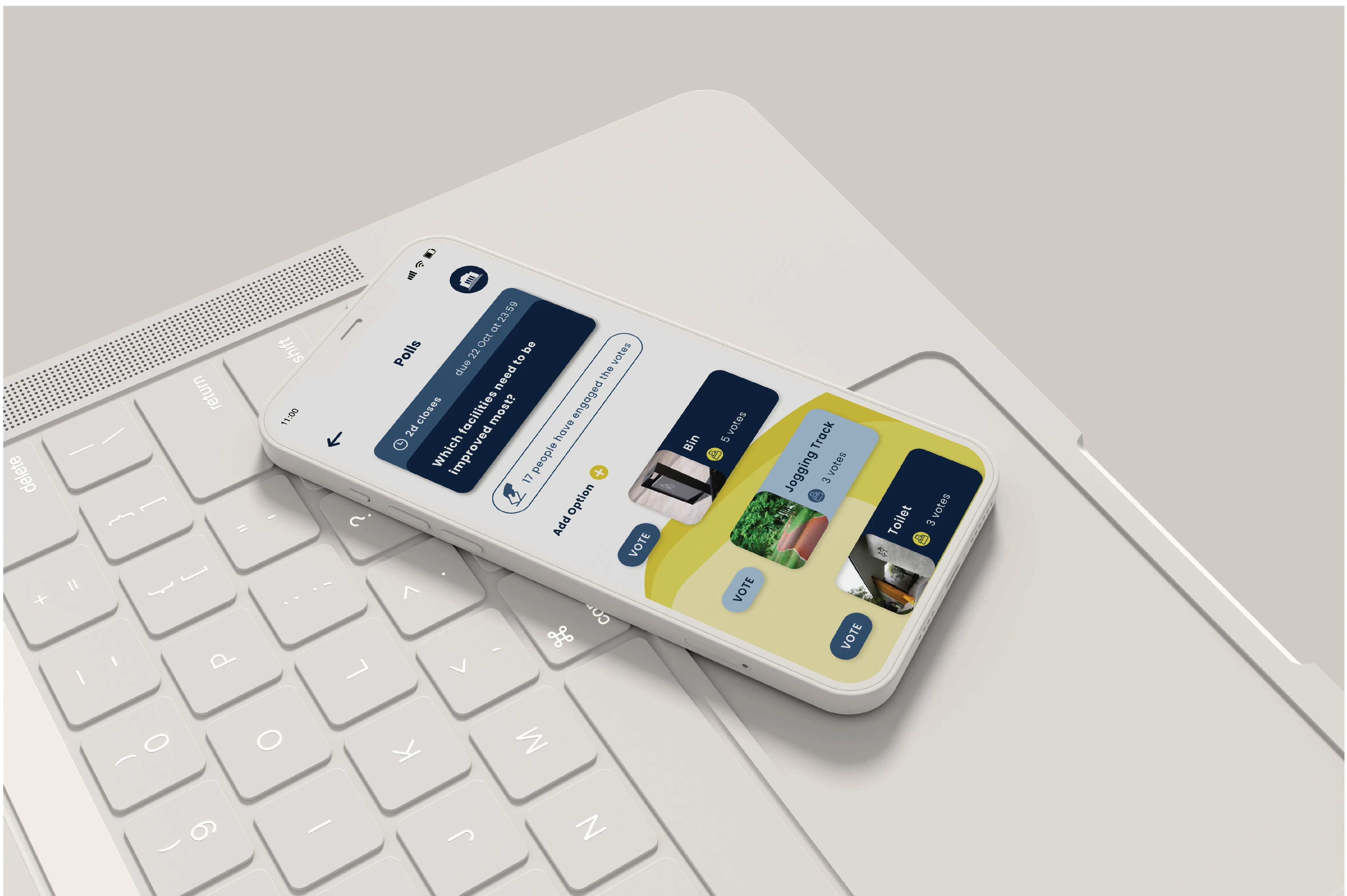
Community polls allow options to be proposed and voted on. Results show the total response as well as representation from each stakeholder group. This helps users understand whether an apparent majority includes different perspectives or is dominated by one group.
The interface combines green-space photography, organic forms and a navy, green and yellow palette. The visual language was designed to feel approachable for residents while retaining the credibility of a civic service.


Outcome
Talk to Casey demonstrated how qualitative findings from participatory workshops could be translated into a structured digital concept.
The final prototype connected the most consistent research themes with specific product decisions. Fragmented communication informed the shared channels. The need for visible participation informed role identification. Facility-ranking exercises informed the poll interactions and example content.
The outcome was a design proposal rather than a launched government service. It shows how residents, councils and developers might communicate within one environment, but it does not establish that the platform would improve real planning decisions without further testing.
No large-scale evaluation or implementation took place as part of the project.
Reflection
This project strengthened my understanding of participatory design and the responsibility involved in designing for groups with unequal influence.
The workshops showed that inclusive engagement requires more than giving people a space to comment. Participants also need accessible information, clarity about who is involved and visibility into how contributions relate to a decision.
Role-based activities were particularly valuable because they encouraged participants to consider constraints beyond their own position. However, they could not fully reproduce the lived experience or authority of another stakeholder group.
If the concept moved forward, I would test it with a larger and more diverse group. Further work would need to address accessibility, moderation, privacy, misinformation, council accountability and the relationship between informal participation and formal decision-making.